
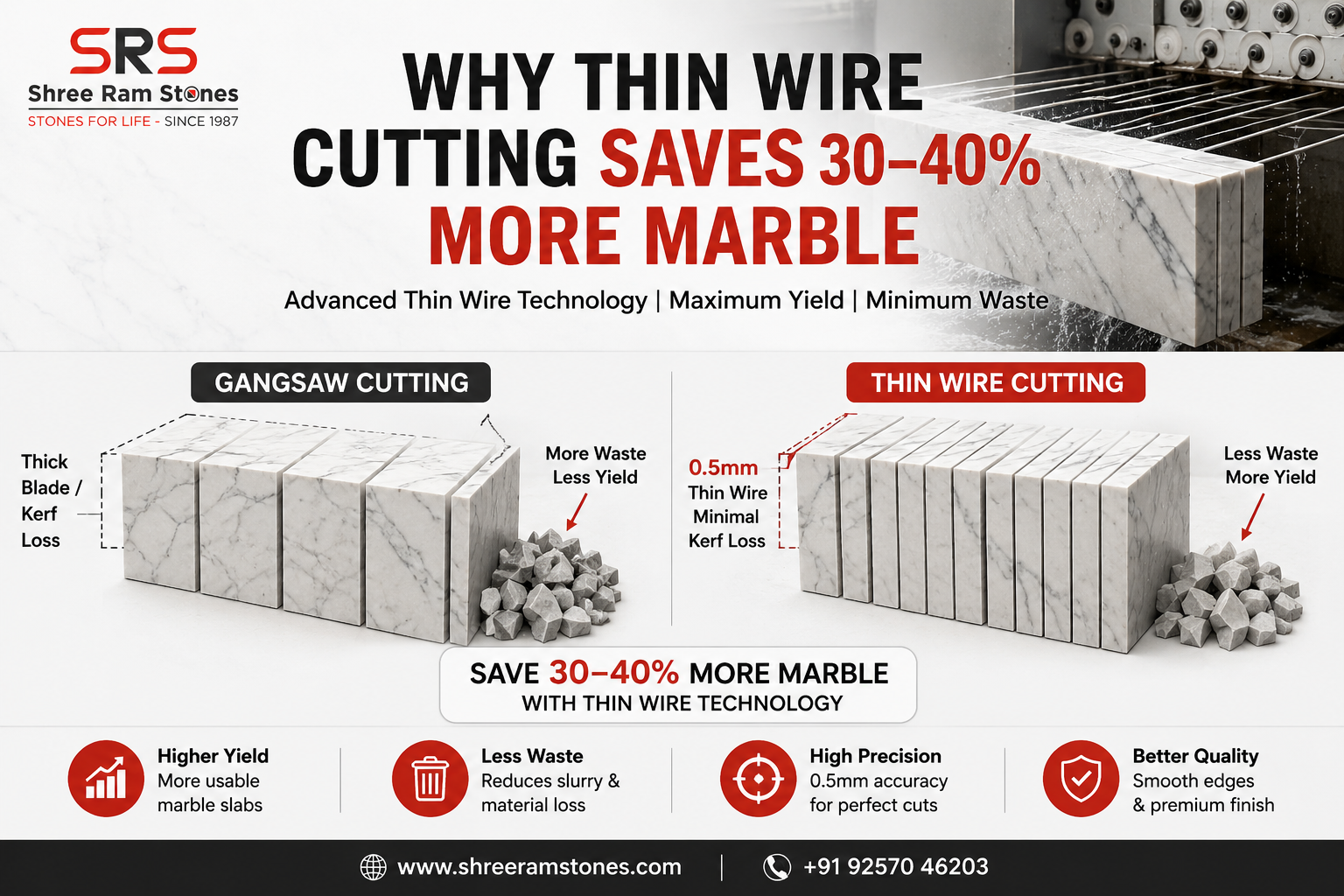
Marble processing requires precision, efficiency, and careful material management. Traditionally, stone manufacturers use thick wire systems for block cutting. However, modern thin wire cutting technology offers a smarter alternative.
Thin wire cutting uses a narrower cutting wire than conventional systems. Therefore, it removes less marble during the cutting process. This reduction can significantly improve slab recovery and reduce production waste.
For premium marble, even a small saving can create major financial benefits. As a result, many modern marble processors are adopting thin wire cutting technology.
What Is Thin Wire Cutting?
Thin wire cutting uses a diamond-coated wire with a smaller cutting diameter. The wire passes through the marble block with controlled pressure and high precision.
Unlike traditional cutting methods, thin wire technology creates a narrower kerf. Kerf refers to the material removed during cutting.
Consequently, less marble turns into cutting waste. More material remains available for producing finished slabs.
This technology works especially well with valuable natural stones. Premium white marble, Italian marble, exotic marble, and other high-value materials can benefit significantly.
How Thin Wire Cutting Reduces Marble Waste
The biggest advantage comes from the reduced cutting width. Every slab requires a cut through the marble block.
With conventional cutting, each cut removes a measurable amount of stone. When hundreds of cuts are required, those small losses become substantial.
Thin wire cutting reduces the width of each cutting path. Therefore, manufacturers can recover more usable stone from the same block.
For example, a marble block may require dozens of parallel cuts. A small reduction in kerf across every cut can preserve considerable material.
As a result, overall marble recovery can improve by approximately 30–40% in suitable cutting conditions.
The exact saving depends on the wire diameter, block size, marble quality, cutting pattern, and machine settings.
Why Marble Recovery Matters
Marble blocks represent a significant investment for manufacturers and exporters. Therefore, maximizing every usable square meter is essential.
Higher recovery means more finished slabs from the same raw block. Consequently, manufacturers can reduce the material cost allocated to every slab.
Furthermore, improved recovery helps minimize discarded stone. This approach supports better resource utilization throughout the production process.
For expensive marble varieties, the financial impact becomes even greater. Saving additional material from one block can substantially improve overall production value.
Thin Wire Cutting Improves Slab Yield
Slab yield refers to the amount of finished material obtained from a raw marble block.
A narrower cutting wire allows manufacturers to create more efficient cutting patterns. Moreover, it reduces unnecessary material loss between individual slabs.
As a result, the same block can produce more usable slabs.
Higher slab yield also helps marble suppliers maintain consistent inventory. Additionally, it can support better pricing for large construction projects.
This advantage becomes particularly important when processing large commercial orders.
Better Precision During Marble Processing
Thin wire cutting does more than reduce material waste. It can also provide accurate and controlled cutting.
Modern diamond wire systems maintain consistent cutting performance across the marble block. Therefore, manufacturers can achieve more uniform slab thickness.
Better control can also reduce unnecessary trimming. Consequently, more of each slab remains available for final processing.
Precision becomes especially important for architectural marble projects. Large floors, wall panels, hotels, villas, and commercial interiors require consistent slab dimensions.
Lower Production Waste
Traditional cutting methods can generate substantial stone waste during processing. This waste may include kerf loss, trimming loss, and damaged sections.
Thin wire cutting addresses one of the major sources of loss. By reducing the cutting path, it preserves more material inside the block.
Additionally, better cutting control can reduce unnecessary corrections. Therefore, manufacturers can improve production efficiency while reducing avoidable waste.
Lower waste also supports more sustainable marble processing.
Financial Benefits for Marble Manufacturers
The economic benefits of thin wire cutting extend beyond material savings.
First, manufacturers can obtain more slabs from each purchased block. Second, they can reduce the average raw. Therefore, manufacturers can improve production efficiency while reducing avoidable waste.
Lower waste also supports more sustainable marble processing.
Financial Benefits for Marble Manufacturers
The economic benefits of thin wire cutting extend beyond material savings.
First, manufacturers can obtain more slabs from each purchased block. Second, they can reduce the average raw material cost per finished slab.
Furthermore, improved recovery can increase the profitability of premium marble products.
For exporters, these savings can also improve price competitiveness. Manufacturers can potentially offer attractive quotations without compromising product quality.
Therefore, cutting technology plays an important role in modern marble manufacturing.
Thin Wire Cutting and Sustainable Stone Processing
Natural stone is a valuable resource that requires responsible utilization. Consequently, reducing unnecessary marble waste has both environmental and commercial advantages.
Thin wire cutting helps maximize the usable portion of each quarry block. Less discarded material means better utilization of extracted stone.
Moreover, improved recovery can reduce the need to process additional blocks for the same finished quantity.
This makes thin wire cutting an important technology for more efficient stone manufacturing.
Choosing the Right Marble Processing Technology
Thin wire cutting can deliver impressive results when manufacturers use the correct equipment and settings.
Wire quality, diamond concentration, cutting speed, block characteristics, and machine maintenance all influence performance.
Therefore, manufacturers should select technology according to their marble type and production requirements.
Experienced stone processors can optimize cutting parameters to achieve better recovery and consistent slab quality.
Conclusion
Thin wire cutting can transform the economics of marble processing. Its narrower kerf reduces material loss and improves block utilization.
Under suitable conditions, manufacturers can achieve approximately 30–40% better material recovery compared with conventional cutting methods.
Moreover, the technology supports higher slab yield, better precision, lower waste, and improved production efficiency.
For premium marble manufacturers, every saved centimeter of stone matters. Therefore, investing in efficient cutting technology can create long-term value across the entire production process.
Contact Information
Shree Ram Stone and Company
Premium Marble & Granite Manufacturer | Exporter | Supplier Since 1987
📍 Address:
Makrana Road, RIICO Industrial Area,
Kishangarh, Khatoli, Rajasthan – 305801, India
📞 Call / WhatsApp:
+91 92521 01111
📧 Email:
ceo@shreeramexpo.in
shreeramexpo@gmail.com
🌐 Website:
https://www.shreeramstones.com/
https://www.stoneexpert.in/
For Marble & Granite Enquiries:
Contact Shree Ram Stone and Company for premium marble, granite, custom cutting, bulk orders, and export requirements.
Frequently Asked Questions (FAQ)
1. What is thin wire cutting in marble processing?
Thin wire cutting uses a narrow diamond wire to cut marble blocks into slabs. It creates a smaller kerf and reduces material loss.
2. How much marble can thin wire cutting save?
Thin wire cutting can potentially improve marble recovery by 30–40% under suitable conditions. Actual savings depend on block size, wire diameter, and cutting settings.
3. Why does thin wire cutting reduce marble waste?
The thinner wire creates a narrower cutting path. Therefore, less marble becomes cutting waste between individual slabs.
4. Does thin wire cutting improve slab production?
Yes. A narrower kerf allows more usable material to remain inside the block. Consequently, manufacturers can achieve a higher slab yield.
5. Is thin wire cutting suitable for premium marble?
Yes. Thin wire cutting is particularly valuable for premium and expensive marble varieties. It helps maximize the usable material from costly blocks.
6. Can thin wire cutting improve marble cutting precision?
Yes. Modern diamond wire systems provide controlled and accurate cutting. Proper machine settings can also help maintain consistent slab thickness.
7. Does thin wire cutting reduce production costs?
It can reduce raw material costs per finished slab by improving block recovery. Additionally, lower waste can improve overall production efficiency.
8. What affects marble recovery during wire cutting?
Several factors affect recovery, including wire diameter, marble quality, block dimensions, cutting speed, machine settings, and operator experience.
9. Is thin wire cutting environmentally beneficial?
Yes. Better block utilization means less marble waste. As a result, manufacturers can use extracted natural stone more efficiently.
10. Where can I enquire about marble processing and supply?
You can contact Shree Ram Stone and Company for marble, granite, stone processing, bulk orders, and export enquiries.