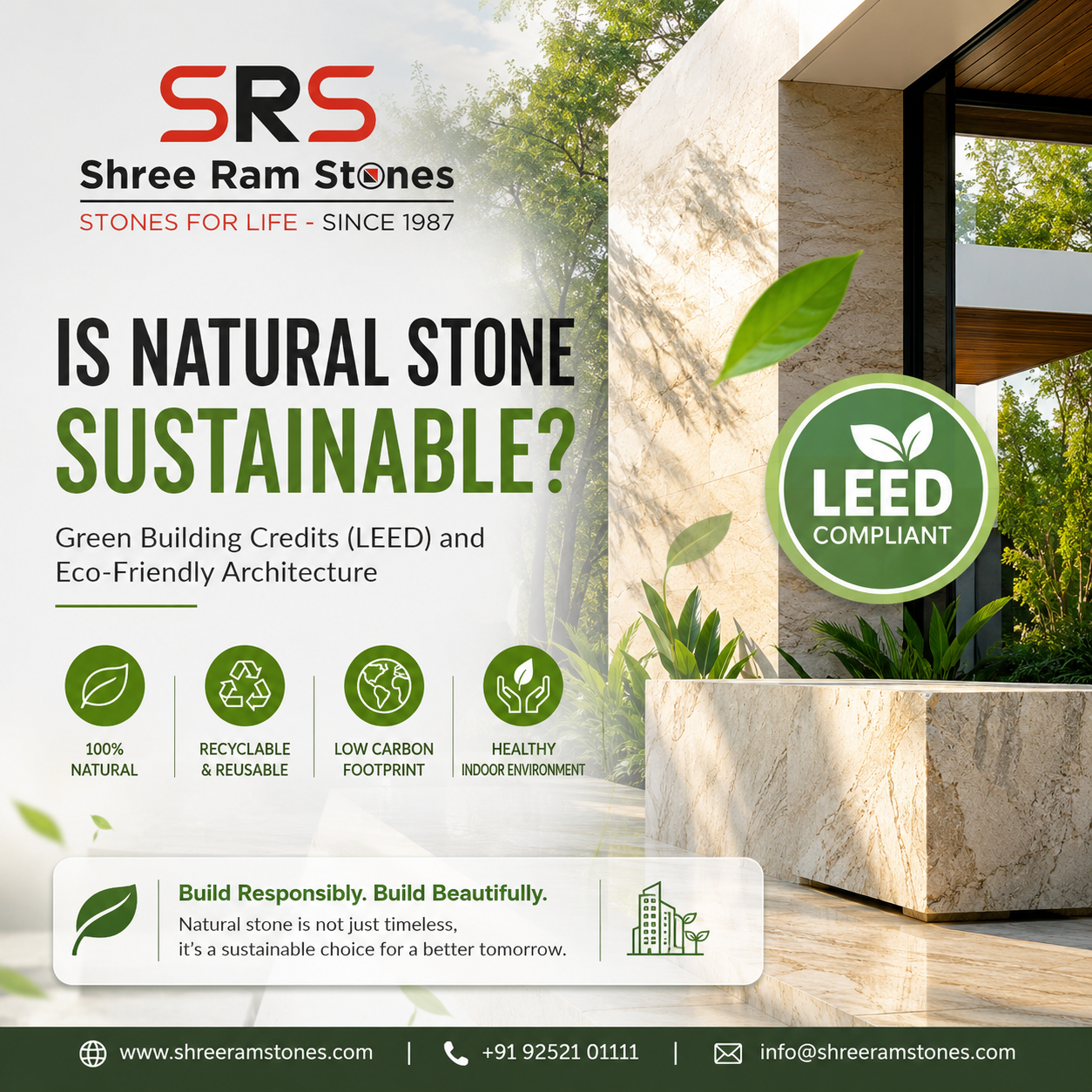
Sustainable architecture is no longer simply a design trend. Today, architects, builders, developers, and homeowners are increasingly looking for materials that combine beauty, durability, responsible sourcing, and lower environmental impact. This has naturally raised an important question: Is natural stone sustainable?
The short answer is yes—but sustainability depends on how the stone is quarried, processed, transported, installed, maintained, and eventually reused.
Natural stone such as marble, granite, limestone, sandstone, and slate is formed by geological processes over thousands or millions of years. Unlike synthetic finishes that may require several manufactured components, natural stone is a naturally occurring material that can provide exceptional service life. With responsible quarrying, efficient fabrication, appropriate transportation, and thoughtful design, stone can become an important part of an eco-friendly building strategy.
For green building projects, however, simply choosing a natural material does not automatically guarantee LEED points. Modern green-building systems increasingly evaluate materials through life-cycle impacts, environmental product declarations, responsible sourcing, embodied carbon, transparency, and other measurable criteria.
So, how sustainable is natural stone? And how can architects use marble and granite in eco-friendly architecture while supporting green building goals?
Let’s explore.
What Makes Natural Stone a Sustainable Building Material?
Natural stone has several characteristics that can support sustainable construction.
First, stone is naturally occurring. It does not begin as a synthetic resin, plastic composite, or chemically manufactured surface. The material is extracted from the earth and then cut, finished, and fabricated into products such as slabs, tiles, steps, countertops, walls, and architectural elements.
Second, natural stone is exceptionally durable. A properly selected and installed stone surface can remain functional and attractive for decades. This long service life matters because replacing a floor or façade repeatedly requires additional raw materials, manufacturing, transportation, installation, and waste disposal.
Third, many stone products can be repaired, refinished, repurposed, or reused. Salvaged stone can sometimes find a second life in another project, while fabrication offcuts may be suitable for smaller applications.
In other words, sustainability is not just about what happens when a material is manufactured. It is also about what happens during the decades that follow.
Natural Stone and the Life-Cycle Approach
A useful way to understand sustainable materials is to look at the entire life cycle.
The life cycle of natural stone can include:
- Quarrying and extraction
- Cutting and processing
- Finishing and fabrication
- Packaging
- Transportation
- Installation
- Cleaning and maintenance
- Long-term use
- Reuse or disposal
Each stage can influence environmental performance.
For example, a stone quarried responsibly and processed efficiently may have a different environmental profile from a similar product that travels extremely long distances using carbon-intensive transportation.
This is why we should avoid saying that every natural stone product has exactly the same sustainability profile.
LEED’s Materials and Resources approach increasingly emphasizes life-cycle impacts and material transparency rather than relying on a single simplistic definition of a “green material.”
Why Durability Matters in Sustainable Architecture
Imagine installing a floor that looks attractive for only a few years before requiring replacement. Even if its initial environmental impact appears low, repeated replacement can create additional material consumption and construction waste.
Natural stone takes a different approach.
Granite, marble, slate, limestone, and other stones can deliver long-term performance when selected and installed correctly. Their resistance to wear can make them suitable for high-traffic applications, while many stone surfaces can be maintained without replacing the entire installation.
Long Service Life Reduces Replacement
Durability can contribute to sustainability because fewer replacements may mean:
- Less construction waste
- Lower demand for new materials
- Fewer manufacturing cycles
- Fewer installation cycles
- Reduced long-term resource consumption
Of course, durability depends on the specific stone, application, installation method, climate, and maintenance program.
That distinction is important.
Is Quarrying Natural Stone Environmentally Friendly?
This is where the sustainability discussion becomes more complicated.
Natural stone must be extracted from a quarry. Quarrying can affect land, energy consumption, water use, dust, noise, waste generation, and transportation. Therefore, calling natural stone “100% green” without considering extraction would be misleading.
Responsible quarry management can help reduce these impacts.
Good practices may include:
- Efficient extraction planning
- Maximizing usable block recovery
- Reusing stone offcuts
- Managing quarry waste
- Controlling dust and water
- Improving energy efficiency
- Restoring or managing quarry areas responsibly
- Reducing unnecessary transportation
- Documenting environmental performance
The goal is not to pretend quarrying has no impact. The goal is to manage and reduce those impacts throughout the material’s life cycle.
How Stone Waste Can Be Reduced
Stone fabrication produces offcuts and smaller pieces. However, waste does not necessarily mean the material has reached the end of its useful life.
Smaller pieces can potentially be used for:
- Mosaic designs
- Small countertops
- Steps
- Wall accents
- Landscaping
- Furniture components
- Decorative features
- Sample pieces
- Smaller tiles
Quarry and fabrication waste can also sometimes be crushed or processed for other applications, depending on local requirements and technical suitability.
This approach supports a circular-material mindset: use as much of the extracted resource as possible rather than treating every leftover piece as disposable waste.
Natural Stone and Embodied Carbon
Embodied carbon has become an increasingly important topic in sustainable construction.
Operational carbon relates to energy used while a building is occupied. Embodied carbon, by contrast, is associated with activities such as extracting raw materials, manufacturing products, transporting them, constructing buildings, and eventually processing or disposing of materials.
LEED v5 places significant attention on embodied carbon reduction. Its Materials and Resources requirements include pathways involving whole-building life-cycle assessment, environmental product declaration analysis, and tracking construction-related carbon emissions.
This makes documentation increasingly important.
Instead of asking only, “Is this stone natural?”, project teams may also ask:
Where did it come from? How was it produced? How far did it travel? What environmental information is available? How long will it last?
Those questions provide a much more useful sustainability assessment.
Can Natural Stone Help With LEED Certification?
Yes, natural stone can potentially contribute to a LEED project, but there is an important distinction.
Using natural stone does not automatically earn LEED points.
LEED credits are awarded according to specific requirements, documentation, calculations, and rating-system rules. The exact contribution depends on the project’s LEED version, rating system, product documentation, sourcing, and applicable credit pathway.
Current LEED systems include requirements and pathways related to environmental product declarations, life-cycle impacts, responsible sourcing, and embodied carbon.
Therefore, architects should evaluate the stone product against the specific LEED requirements instead of assuming that “natural” equals “LEED certified.”
What Are Environmental Product Declarations (EPDs)?
An Environmental Product Declaration, commonly called an EPD, provides environmental information about a product based on life-cycle assessment.
For sustainable architecture, this information can be extremely useful.
An EPD can help project teams understand environmental impacts associated with a product and compare documented information during material selection.
USGBC guidance for EPD-related credits explains that project teams should specify compliant products and track purchases and construction documentation to support credit requirements.
Why EPDs Matter for Stone
For a natural stone supplier or manufacturer, environmental documentation can make it easier for architects and sustainability consultants to evaluate products.
Depending on the applicable LEED requirements, documentation can be relevant to:
- Life-cycle assessment
- Environmental impacts
- Product disclosure
- Material selection
- Embodied-carbon analysis
- LEED documentation
This is one reason the future of sustainable stone is likely to involve not only attractive slabs but also better environmental data.
Responsible Sourcing and Natural Stone
Responsible sourcing is another important part of green building.
A stone product may be natural, but project teams still need information about its extraction and supply chain.
Questions worth asking include:
- Where was the stone quarried?
- Where was it processed?
- Where was it purchased?
- How far did it travel?
- Is environmental documentation available?
- Can the supplier provide product information required by the project’s rating system?
- How much fabrication waste is generated?
- Can leftover stone be reused?
These questions turn sustainability from a marketing statement into a measurable procurement process.
Does Local Stone Have an Environmental Advantage?
Transportation can influence the environmental footprint of building materials.
A product that travels shorter distances may reduce transportation-related impacts compared with an otherwise similar product shipped much farther. Local procurement can also support regional economies.
LEED has included location-related valuation approaches in its Materials and Resources framework, although the exact requirements vary by rating system and version. For example, LEED v4 documentation describes a 100-mile location valuation factor for qualifying products that meet applicable sustainability criteria.
This means project teams should check the current requirements rather than relying on older “500-mile rule” information frequently repeated online.
Why Location Documentation Matters
For stone projects, documentation may include information about:
- Quarry location
- Processing facility
- Fabrication facility
- Purchase location
- Transportation route
- Product cost
- Environmental documentation
The closer the supply chain, the easier it may be to reduce unnecessary transportation impacts—but location alone is not the entire sustainability story.
Natural Stone Compared With Synthetic Alternatives
Comparing natural stone with manufactured alternatives is not as simple as asking which material is “green.”
Different products have different manufacturing processes, transportation distances, durability, maintenance requirements, and end-of-life possibilities.
A fair comparison should consider:
- Raw material extraction
- Manufacturing energy
- Chemical inputs
- Transportation
- Product lifespan
- Maintenance
- Replacement frequency
- Repairability
- Reuse potential
- End-of-life options
For example, a synthetic surface may contain recycled content, while a natural stone may offer exceptional longevity. Both characteristics can matter, but they address different parts of the environmental equation.
This is why life-cycle thinking is more useful than judging materials by a single label.
Natural Stone in Eco-Friendly Architecture
Eco-friendly architecture is about designing buildings that use resources intelligently while providing comfort, performance, and long-term value.
Natural stone can fit into this philosophy in several ways.
Stone Flooring
Stone flooring can be used in residential, hospitality, retail, and commercial buildings.
Its durability makes it attractive for spaces where surfaces experience heavy foot traffic. With appropriate selection and maintenance, stone flooring can remain functional for many years.
Stone Walls and Cladding
Natural stone cladding can provide a durable architectural finish.
Depending on the system, stone can contribute to visual longevity and reduce the need for frequent cosmetic replacement.
Stone Countertops
Granite and marble are commonly used for countertops because of their combination of aesthetics and performance.
Long-lasting surfaces can help reduce replacement cycles, especially when homeowners maintain them appropriately.
Outdoor Applications
Natural stone can also be used for:
- Patios
- Walkways
- Landscape walls
- Steps
- Courtyards
- Garden features
- Outdoor seating areas
For outdoor applications, however, the selected stone should be appropriate for the local climate, moisture conditions, freeze-thaw exposure where applicable, and expected traffic.
Can Stone Improve Building Longevity?
Think of a building as a long-term investment rather than a temporary product.
Every surface has a useful life. When durable materials remain attractive and functional for decades, owners may have fewer reasons to replace them simply because they have become worn.
This is one of natural stone’s strongest sustainability arguments.
A material that lasts longer can spread its initial environmental impact over a longer period of service.
That does not make every stone automatically sustainable, but it makes durability an important factor in the overall life-cycle equation.
Maintenance and Sustainability
Sustainability does not end when installation is complete.
A material that requires excessive replacement, harsh chemicals, or complicated maintenance may have a different environmental profile from a durable material that can be maintained with appropriate routine care.
Natural stone maintenance varies by stone type and finish.
For example:
- Follow manufacturer or fabricator recommendations.
- Use suitable cleaning products.
- Avoid inappropriate acidic cleaners on acid-sensitive stones.
- Address spills promptly when recommended.
- Reseal applicable stones when required.
- Repair minor problems rather than immediately replacing large areas.
Proper maintenance can extend service life and protect the original investment in the material.
Can Reclaimed Stone Support Circular Construction?
Absolutely.
Reclaimed and salvaged stone can be particularly interesting from a circular-economy perspective because the material has already been extracted and processed.
Instead of producing an entirely new surface, designers may be able to reuse existing stone in another application.
USGBC materials guidance recognizes reuse and salvaged materials as relevant sustainability attributes in applicable LEED pathways.
Reclaimed stone can be used for:
- Heritage restoration
- Garden walls
- Flooring
- Paving
- Steps
- Feature walls
- Furniture
- Decorative applications
Availability and technical condition must always be checked before specifying reclaimed material.
How Architects Can Specify Sustainable Stone
Architects can improve the sustainability of a stone specification by considering the entire supply chain early in the design process.
A practical strategy is to request environmental information before finalizing the material.
A Sustainable Stone Specification Checklist
Consider requesting:
- Stone type and geological origin
- Quarry location
- Processing location
- Fabrication location
- Product dimensions
- Finish specifications
- Expected service conditions
- Maintenance requirements
- Waste-management practices
- EPD or LCA documentation where available
- Responsible sourcing documentation
- Transportation information
- Reuse or recycling possibilities
This approach helps the design team make decisions based on evidence rather than assumptions.
Natural Stone and LEED: What Project Teams Should Remember
LEED is a rating system, not a simple list of “green materials.”
A product’s eligibility can depend on the project’s rating system and the exact credit requirements. LEED v5, for example, includes dedicated attention to embodied carbon and provides pathways involving whole-building life-cycle assessment and EPD analysis.
Therefore, project teams should always verify the current LEED reference guide and applicable credit requirements before claiming a particular point.
For Indian projects, regional considerations can also matter. USGBC provides India-specific regional priority and alternative compliance information for applicable LEED systems.
Common Myths About Sustainable Natural Stone
Myth 1: Every Natural Stone Is Automatically Green
Not necessarily.
Natural origin is only one part of sustainability. Extraction, processing, transportation, waste, durability, and documentation also matter.
Myth 2: Natural Stone Automatically Gives LEED Points
No.
LEED points depend on applicable requirements and documentation. A natural stone product must satisfy the relevant credit pathway to contribute.
Myth 3: Imported Stone Cannot Be Sustainable
Not automatically.
Transportation is an important consideration, but sustainability involves multiple life-cycle factors. An imported product should be evaluated using actual environmental information rather than its country of origin alone.
Myth 4: Stone Waste Has No Value
Stone offcuts can sometimes be reused or repurposed, particularly when fabrication is planned efficiently.
How Natural Stone Suppliers Can Support Green Building Projects
The role of suppliers is becoming increasingly important.
Architects and sustainability consultants need reliable product information. Suppliers can support them by maintaining clear documentation and providing transparent information about their materials.
Useful information can include:
- Product origin
- Quarry information
- Processing details
- Available finishes
- Technical specifications
- Environmental declarations
- Responsible sourcing information
- Packaging details
- Waste-reduction practices
The more transparent the supply chain becomes, the easier it is for design teams to make informed decisions.
The Future of Sustainable Stone
The future of sustainable natural stone is not simply about extracting more stone.
It is about extracting smarter, processing more efficiently, reducing waste, improving documentation, increasing reuse, optimizing transportation, and measuring environmental performance.
The industry is also moving toward a more data-driven approach to sustainability. As green building standards place greater emphasis on embodied carbon and life-cycle impacts, manufacturers and suppliers that can provide credible environmental data will become increasingly valuable to architects and developers.
This is an exciting shift.
Instead of asking only, “Does this stone look beautiful?” designers can ask, “How does this stone perform environmentally over its entire life?”
Practical Tips for Choosing Sustainable Natural Stone
If you are planning a green building project, consider these practical steps:
- Choose durable stone for the application.
- Ask about quarry and processing locations.
- Compare transportation requirements.
- Request EPD or LCA information where available.
- Minimize unnecessary fabrication waste.
- Consider reclaimed stone when appropriate.
- Design for long service life.
- Use appropriate maintenance methods.
- Keep documentation for LEED submissions.
- Verify current LEED requirements before claiming credits.
These steps can make natural stone procurement more responsible and transparent.
Why Natural Stone Remains Relevant to Green Architecture
Sustainable architecture does not require every building to look the same.
Natural stone gives designers an opportunity to combine environmental considerations with texture, color, character, and timeless design.
A marble floor can create a refined interior. Granite can provide a durable working surface. Stone walls can create a strong architectural identity. Outdoor stone can connect buildings with landscapes.
When these materials are selected responsibly and designed for long service life, they can become part of a broader sustainable strategy.
Conclusion: Is Natural Stone Sustainable?
So, is natural stone sustainable?
Yes, natural stone can be a sustainable building material when it is responsibly quarried, efficiently processed, appropriately transported, carefully specified, properly maintained, and reused wherever practical.
Its durability and long service life are major advantages. At the same time, quarrying, processing, transportation, and waste must be considered honestly. A natural material is not automatically a low-impact material.
For LEED and eco-friendly architecture, the strongest approach is to evaluate stone through the complete life cycle. Environmental Product Declarations, life-cycle assessments, responsible sourcing information, embodied-carbon data, and project-specific documentation can help architects and developers make better decisions. Current LEED requirements increasingly emphasize measurable environmental performance rather than simply identifying materials as “green.”
Ultimately, sustainable architecture is about making smarter choices.
Natural stone can be one of those choices—especially when beauty, durability, responsible sourcing, and long-term performance are considered together.
FAQs About Natural Stone Sustainability
1. Is natural stone considered an eco-friendly material?
Natural stone can be eco-friendly when responsibly quarried, efficiently processed, transported appropriately, and used for a long service life. Sustainability depends on the complete life cycle rather than simply the material’s natural origin.
2. Can natural stone earn LEED points?
Natural stone may contribute to applicable LEED credits when it satisfies the requirements of the relevant rating system and credit pathway. Products do not receive LEED points automatically simply because they are natural.
3. What LEED documentation can be useful for natural stone?
Depending on the applicable credit, useful documentation may include Environmental Product Declarations, life-cycle assessment information, sourcing details, environmental data, product information, and purchase documentation. Requirements vary by LEED version and rating system.
4. Is locally sourced natural stone more sustainable?
Local sourcing can reduce transportation-related impacts and may provide additional benefits under applicable green-building criteria. However, the complete environmental profile should be considered, including extraction, processing, durability, and transportation.
5. Is marble sustainable for modern architecture?
Marble can be a sustainable choice when responsibly sourced and used in applications where its durability and long service life can be fully utilized. Responsible sourcing, efficient fabrication, transportation, maintenance, and potential reuse should all be considered.
Contact Information
Shree Ram Stone and Company
Makrana Road, RIICO Industrial Area, Kishangarh, Khatoli, Rajasthan – 305801, India
Phone: +91 92521 01111
Email: ceo@shreeramexpo.in | shreeramexpo@gmail.com
Website: https://www.shreeramstones.com/
Stone Products: https://www.stoneexpert.in/
Trusted Since 1987 | Manufacturer | Export Supplier | Factory Direct