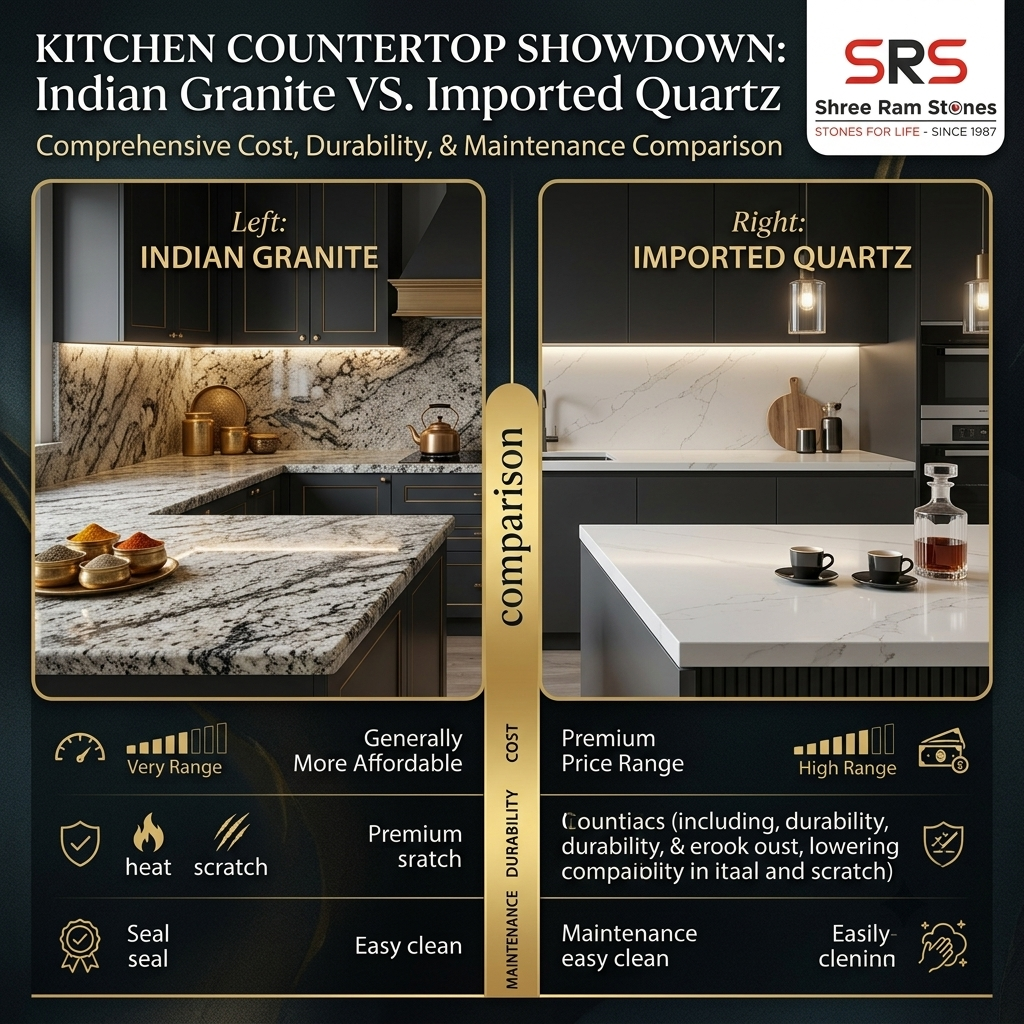
Choosing the right kitchen countertop is an important decision because the surface needs to combine durability, appearance, maintenance, and value for money. Two popular choices today are Indian granite and imported quartz. Both offer attractive finishes, but they differ significantly because granite is a natural stone while engineered quartz is a manufactured surface.
If you are comparing Indian granite vs quartz countertops, this guide will help you understand their differences in cost, durability, heat resistance, maintenance, appearance, and long-term value.
At Shree Ram Stones, buyers can explore a wide selection of granite and other natural stones for residential and commercial projects. The company offers granite in different colors, patterns, thicknesses, and finishes for countertops, flooring, walls, and other applications.
When comparing Indian granite vs quartz countertops
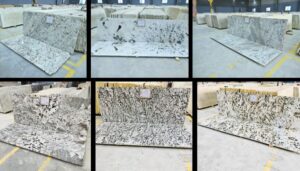
Indian granite is a natural igneous stone formed under intense heat and pressure over millions of years. Each slab has its own mineral composition, colors, veins, and patterns. This natural variation makes every granite countertop visually distinctive.
Quartz countertops, on the other hand, are engineered surfaces manufactured using quartz minerals combined with resins, pigments, and other materials. Their production allows manufacturers to create highly consistent colors and patterns.
For homeowners, the decision usually comes down to priorities:
- Choose granite for natural character, strong heat performance, and a wide variety of natural patterns.
- Choose quartz for consistent designs, low routine maintenance, and a broad range of engineered colors.
- Choose premium Indian granite when you want natural stone aesthetics combined with competitive sourcing and long-term durability.
The cost of Indian granite vs quartz countertops…
Cost is one of the first things homeowners consider when selecting a countertop.
The final price of a countertop depends on several factors, including:
- Stone quality
- Brand or supplier
- Color and rarity
- Slab thickness
- Surface finish
- Edge profile
- Cutting and fabrication
- Sink and hob cut-outs
- Transportation
- Installation
- Project quantity
Therefore, there is no single fixed price for either granite or quartz.
Indian granite can provide excellent value because India has a large natural-stone industry and offers many varieties at different price levels. For example, Shree Ram Stones lists granite options ranging from more economical varieties to premium and exotic stones.
Some granite options available through Shree Ram Stones include Alaska Granite https://www.shreeramstones.com/product/alaska-granite/, Azul White Granite https://www.shreeramstones.com/product/azul-white-granite/, Absolute Black Granite, Alaska Gold Granite, Colonial White Granite, and other varieties.
Imported quartz can have a higher purchase price depending on the manufacturer, design, thickness, and country of origin. In addition, imported products may include logistics, distribution, and other supply-chain costs.
Is Indian Granite More Affordable Than Imported Quartz?
In many projects, Indian granite can be a cost-effective alternative to imported engineered surfaces. However, buyers should compare the complete installed cost, not simply the price per square foot.
A low-cost slab may become expensive after fabrication, transportation, installation, and additional finishing are included.
For accurate budgeting, always request a project-specific quotation based on slab selection, dimensions, thickness, finish, and fabrication requirements.
For Indian granite vs quartz countertops
One of the biggest differences between granite and quartz is how they respond to high temperatures.
Heat Resistance Granite vs Quartz
Granite is a natural stone formed under extremely high geological temperatures. It generally performs very well around normal kitchen heat and is widely used for kitchen countertops.
Quartz countertops contain resin as part of their engineered composition. Because of this, prolonged exposure to very hot cookware can potentially damage or discolor the surface.
For this reason, homeowners should use trivets or heat-resistant pads when placing hot cookware directly on a quartz countertop.
Granite is not completely immune to thermal damage. Sudden extreme temperature changes can affect natural stone, particularly if the slab has existing weaknesses or fabrication issues. However, for everyday kitchen use, granite is generally considered an excellent choice for heat-prone countertop applications.
Winner for heat resistance: Indian granite.
For Indian granite vs quartz countertops, both materials offer excellent durability when properly selected and installed
Kitchen countertops experience constant use. They are exposed to cutting, food preparation, spills, heavy cookware, and daily cleaning.
Granite is recognized for its strength and durability. Shree Ram Stones describes granite as a strong and durable architectural stone suitable for demanding applications.
High-quality granite can provide decades of service when properly selected, fabricated, installed, and maintained.
Quartz is also highly durable and designed for everyday residential use. Its engineered composition provides consistent performance and makes it resistant to many common forms of household wear.
However, neither material should be treated as indestructible.
Avoid:
- Cutting directly on the countertop
- Dropping extremely heavy objects on edges
- Using harsh chemicals unnecessarily
- Applying excessive force to unsupported overhangs
- Ignoring cracks or installation problems
Winner for natural-stone durability: Indian granite.
Maintenance: Which Countertop Is Easier to Maintain?
Maintenance is another major consideration.
Granite Maintenance
Granite is relatively easy to clean. Routine maintenance generally involves:
- Wiping spills promptly.
- Cleaning with a suitable stone-safe cleaner.
- Avoiding aggressive acidic or abrasive products.
- Using cutting boards.
- Using trivets for very hot cookware.
- Following the fabricator’s recommendations regarding sealing.
Some granite varieties may benefit from periodic sealing because natural stones can vary in porosity.
Quartz Maintenance
Quartz is popular because it generally requires simple daily cleaning. Its engineered surface is designed to resist many common kitchen stains.
A soft cloth, mild cleaner, and regular wiping are usually sufficient for everyday cleaning.
However, quartz still requires sensible care. High heat, abrasive products, and unsuitable chemicals should be avoided.
Winner for everyday maintenance: Imported quartz.
Appearance and Design Choices
Appearance is subjective, but the two materials offer very different design experiences.
Granite provides genuine natural variation. No two slabs are exactly identical. This can be especially attractive for luxury kitchens where the countertop itself is intended to become a design feature.
Indian granite is available in white, black, grey, gold, pink, blue, and multi-color patterns. Shree Ram Stones offers numerous granite varieties, including Alaska Gold, Alaska Pink, Alaska Grey Gold, Black Galaxy, Blue Pearl, Exotic White, and others.
Quartz provides more predictable visual consistency. This can be useful when a designer wants a uniform contemporary appearance throughout a kitchen.
For a natural luxury aesthetic, granite is often preferred. For consistent minimalist designs, quartz can be an excellent option.
Indian Granite vs Imported Quartz for Kitchen Islands
Kitchen islands often become the focal point of a modern kitchen. The material needs to look attractive from multiple angles while handling everyday use.
Granite is particularly effective for statement islands because natural patterns can create dramatic visual movement. Exotic granites can also resemble artwork, making them suitable for premium villas, hotels, restaurants, and luxury residences.
For example, Patagonia-style and Titanium Gold granite designs can create a strong visual centerpiece.
Quartz works well when the desired look is clean, contemporary, and consistent. It is particularly suitable for minimalist kitchens where uniform color and pattern are important.
Best Choice for a Luxury Kitchen Island
If natural uniqueness is the priority, Indian granite is an excellent choice.
If consistency and a controlled contemporary appearance are more important, quartz may be preferable.
Porcelain vs Natural Marble Price: How Does It Compare?
Another common search among homeowners is porcelain vs natural marble price.
Although porcelain and marble are different materials from both granite and quartz, they are often considered for premium interiors and countertops.
Natural marble is quarried from the earth, and each slab has individual veining and mineral characteristics. Premium varieties, particularly rare imported marbles, can command high prices.
Porcelain is manufactured and can reproduce marble-like patterns with greater consistency. Its cost varies according to brand, thickness, design, format, and installation requirements.
Natural marble can offer unmatched authenticity and luxurious veining, while porcelain can provide a practical alternative for certain applications.
For buyers comparing countertop materials, the best approach is to consider:
- Material price
- Fabrication cost
- Installation cost
- Maintenance
- Expected lifespan
- Visual requirements
- Application conditions
Price alone should not determine the final decision.
Which Is Better for Indian Kitchens?
For many Indian kitchens, granite remains a highly practical choice.
Indian cooking frequently involves high-temperature cookware, spices, oils, heavy utensils, and intensive daily preparation. A countertop should therefore offer strong durability and good heat performance.
Indian granite can be particularly attractive because buyers have access to a large variety of domestic stones in different colors and price ranges.
Shree Ram Stones manufactures and processes natural stones using dedicated facilities and advanced machinery for domestic and international markets.
The company also operates processing capabilities for granite and other natural stones, including Absolute Black Granite and Galaxy Black Granite.
Indian Granite vs Imported Quartz: Pros and Cons
| Feature | Indian Granite | Imported Quartz |
|---|---|---|
| Material | Natural stone | Engineered stone |
| Appearance | Unique natural patterns | Consistent manufactured patterns |
| Heat resistance | Excellent for normal kitchen use | Requires greater heat protection |
| Durability | Very high | Very high |
| Maintenance | Easy, may require sealing depending on stone | Generally easy |
| Color consistency | Naturally variable | Highly consistent |
| Design variety | Extensive natural options | Extensive engineered options |
| Natural material appeal | Excellent | Lower than natural stone |
| Long-term value | Excellent | Excellent when properly maintained |
| Best feature | Natural beauty and heat performance | Consistency and easy maintenance |
How to Choose the Right Countertop
Before purchasing, consider these five questions:
1. What Is Your Budget?
Set a complete project budget that includes the slab, fabrication, transportation, installation, edge profile, sink cut-outs, and other requirements.
2. How Much Heat Will the Countertop Experience?
If your kitchen regularly handles very hot cookware, granite deserves serious consideration.
3. Do You Prefer Natural or Consistent Patterns?
Natural stone offers unique slab-to-slab variation. Engineered quartz offers greater visual consistency.
4. How Much Maintenance Are You Comfortable With?
If you prefer a simple daily cleaning routine and minimal additional care, quartz may appeal to you. Granite is also easy to maintain but may require sealing depending on the particular stone and its use.
5. Is the Supplier Reliable?
The quality of the final countertop depends not only on the material but also on slab selection, cutting, polishing, edge fabrication, packaging, transportation, and installation.
A reliable supplier can help you select the right stone for the intended application.
Why Choose Shree Ram Stones for Granite?
Shree Ram Stones is based in Kishangarh, Rajasthan, one of India’s major natural-stone centers. The company supplies and exports marble, granite, onyx, quartz, and other stone products.
Its product range includes granite for countertops, vanity tops, flooring, wall cladding, bathrooms, outdoor applications, and other architectural projects.
Explore the Shree Ram Stones product collection https://www.shreeramstones.com/product/ to compare available granite and marble options.
For buyers interested in manufacturing and processing capabilities, visit the Shree Ram Stones manufacturing unit https://www.shreeramstones.com/manufacturing-unit
You can also explore the company’s granite export solutions https://www.shreeramstones.com/premium-granite-export-solutions-from-kishangarh-by-shree-ram-stones for information about export-quality granite, custom sizes, packaging, and international supply.
Final Verdict: Indian Granite or Imported Quartz?
There is no universal winner because the best countertop depends on your priorities.
If you want natural beauty, strong heat resistance, unique patterns, durability, and a wide selection of Indian stones, Indian granite is an excellent option.
If your priority is consistent appearance, simple routine maintenance, and engineered design options, imported quartz may be the better choice.
For many Indian homeowners, however, granite offers an outstanding combination of performance, aesthetics, and value. With India’s extensive granite resources and processing industry, buyers can choose from a wide range of colors and designs without sacrificing durability.
Before making your final decision, compare actual slabs rather than relying only on photographs. Check the thickness, finish, shade variation, fabrication quality, installation method, and total project cost.
A well-selected countertop can remain a beautiful and functional part of your kitchen for many years.
Frequently Asked Questions
Is Indian granite better than imported quartz?
Indian granite can be better when natural appearance, heat resistance, durability, and value are priorities. Imported quartz may be preferable when consistent patterns and easy routine maintenance are more important.
Which has better heat resistance, granite or quartz?
Granite generally offers better heat performance. Quartz contains resin and should be protected from prolonged exposure to very hot cookware.
Is Indian granite cheaper than imported quartz?
It can be, depending on the granite variety, quartz brand, fabrication, installation, and logistics. Always compare the complete installed price.
Is granite suitable for kitchen countertops?
Yes. Granite is widely used for kitchen countertops because of its strength, durability, appearance, and suitability for everyday kitchen use.
Which is easier to maintain: granite or quartz?
Quartz generally requires very simple routine maintenance. Granite is also relatively easy to maintain, although some varieties may require periodic sealing.
Does every granite slab look the same?
No. Natural granite has natural mineral variation, so slabs can differ in color, movement, and pattern. This is one of the major attractions of natural stone.
Contact Shree Ram Stones
Shree Ram Stone and Company
Makrana Road, RIICO Industrial Area, Kishangarh, Khatoli, Rajasthan – 305801, India
Phone: +91 92521 01111
Email: ceo@shreeramexpo.in
Website: Shree Ram Stones https://www.shreeramstones.com
For countertop, granite, marble, and export requirements, contact Shree Ram Stones for product availability, slab selection, specifications, and project-specific quotations.
| Stone Industry Information: | Link |
|---|---|
| Indian Granite Quality Checklist | https://www.stoneexpert.in/marble-granite-quality-checklist-what-every-buyer-must-know-before-purchase/ |
| Natural Marble vs Engineered Stone | https://www.stoneexpert.in/natural-marble-vs-engineered-stone-the-ultimate-truth-guide/ |
| Premium Granite for Countertops | https://www.stoneexpert.in/product/patagonia-granite/ |
| Stone Selection Guide | https://www.stoneexpert.in/the-biggest-stone-selection-regrets-homeowners-face/ |
| Slab Inspection & Quality Checking | https://www.stoneexpert.in/slab-inspection-quality-checking/ |