
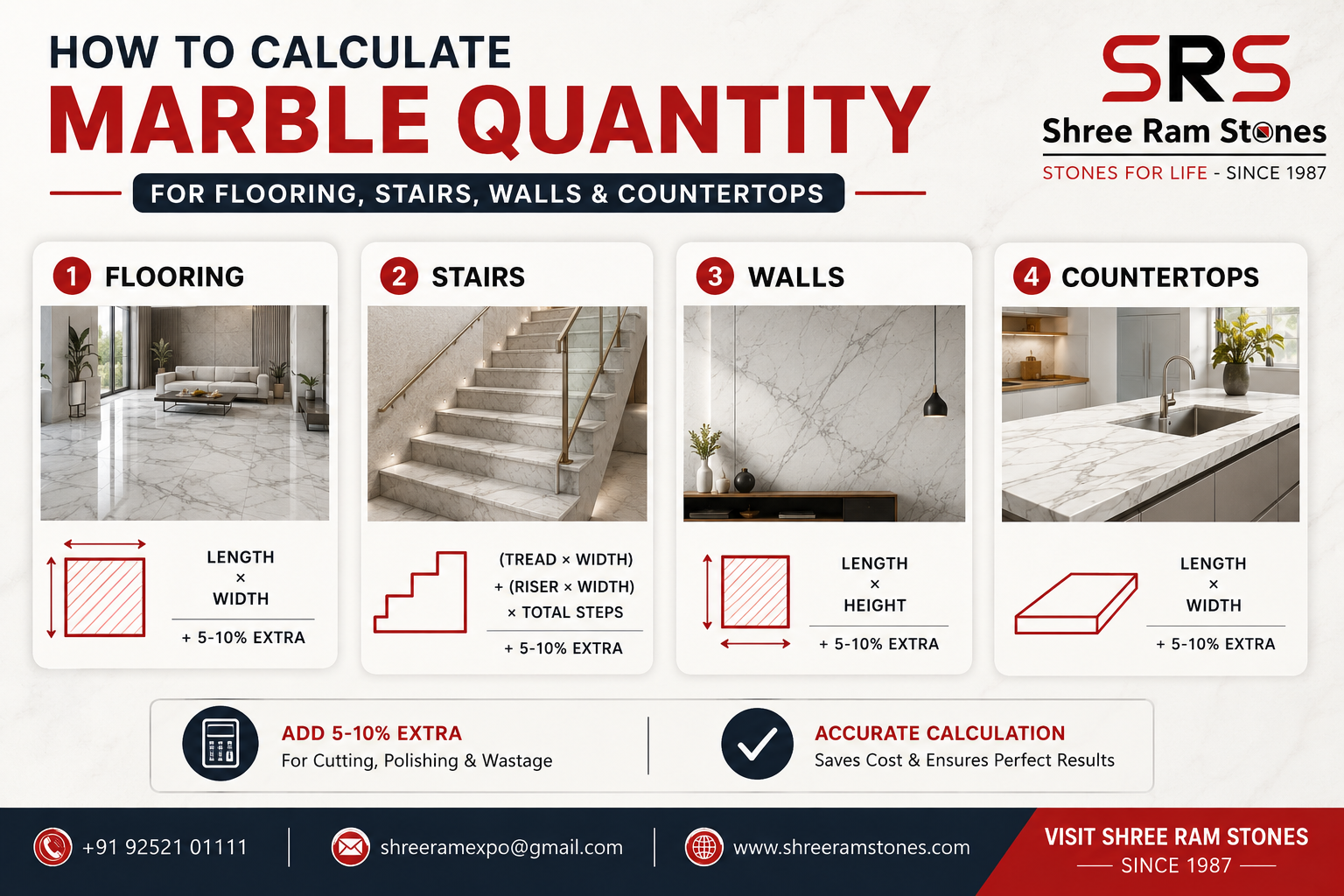
Calculating the right marble quantity before starting a construction or renovation project can save money, reduce material shortages, and minimize unnecessary wastage. Whether you are planning marble flooring, staircase treads, wall cladding, a kitchen countertop, or a bathroom vanity, accurate measurement is the first step.
The basic principle is simple: calculate the surface area, account for openings and cuts, and then add an appropriate wastage allowance. However, flooring, stairs, walls, and countertops each require a slightly different calculation method.
This guide explains how to calculate marble quantity step by step, with practical formulas and examples you can use for residential and commercial projects.
Why Accurate Marble Quantity Calculation Matters
Ordering too little marble can create serious problems. A particular marble lot may not be available later, and replacement slabs can have different colors, veins, or patterns. On the other hand, ordering too much material increases the project budget and can create unnecessary leftover stock.
Natural marble also requires cutting and fabrication. Large slabs may need to be cut around columns, doors, windows, corners, sinks, electrical points, and other architectural features.
The Natural Stone Institute recommends understanding the characteristics of the selected stone and using appropriate installation and maintenance practices. Its technical resources cover marble, countertops, flooring, stairs, wall applications, and other natural-stone installations.
Therefore, the goal is not simply to calculate the exact surface area. You should calculate the usable area plus a suitable cutting and wastage allowance.
Basic Formula for Calculating Marble Quantity
For a simple rectangular surface:
Area = Length × Width
If measurements are in feet:
Area = Length (ft) × Width (ft) = Square Feet
For example, if a room is 20 ft long and 15 ft wide:
20 × 15 = 300 sq. ft.
If you decide to keep 10% extra for cutting and wastage:
300 × 10% = 30 sq. ft.
Therefore:
300 + 30 = 330 sq. ft. of marble
The actual wastage percentage depends on the room shape, marble size, installation pattern, number of cuts, vein matching, and slab layout. Straight layouts generally require less cutting than complicated patterns or book-matched installations.
How to Calculate Marble Quantity for Flooring
Flooring is usually the easiest application to calculate.
Step 1: Measure the Room
Measure the length and width of every rectangular section.
For example:
- Room length = 25 ft
- Room width = 16 ft
Floor area = 25 × 16 = 400 sq. ft.
Step 2: Subtract Permanent Voids
If the floor contains areas that will not receive marble, such as a permanent shaft or certain built-in sections, calculate those separately and deduct them where appropriate.
For example:
- Total floor = 400 sq. ft.
- Permanent opening = 20 sq. ft.
Net area = 400 − 20 = 380 sq. ft.
Step 3: Add Wastage
For a relatively straightforward installation, a practical allowance might be around 7–10%, while complicated layouts can require more. The exact percentage should be finalized with the fabricator or installer because marble slab dimensions and cutting patterns affect actual yield.
Using 10%:
380 × 10% = 38 sq. ft.
Total marble to plan for = 418 sq. ft.
When working with premium veined marble, don’t calculate only by square footage. The cutting layout and vein direction can significantly affect how much of each slab is actually usable.
For premium flooring options, you can explore the Italian Marble collection from Shree Ram Stones, which includes marble suitable for flooring, wall cladding, countertops, and other interior applications.
How to Calculate Marble Quantity for Multiple Rooms
If your project has several rooms, calculate each area separately rather than measuring the entire house as one rectangle.
For example:
Living Room:
20 × 15 = 300 sq. ft.
Bedroom 1:
14 × 12 = 168 sq. ft.
Bedroom 2:
14 × 12 = 168 sq. ft.
Dining Area:
12 × 10 = 120 sq. ft.
Total:
300 + 168 + 168 + 120 = 756 sq. ft.
With 10% allowance:
756 × 1.10 = 831.6 sq. ft.
You would generally plan around 832 sq. ft., subject to the actual slab/tile layout and supplier recommendations.
Measuring each room separately also helps the fabricator create an efficient cutting plan.
How to Calculate Marble Quantity for Stairs
Stairs require more detailed calculations because each step can have a tread, riser, nosing, and sometimes side cladding.
Tread Calculation
The tread is the horizontal surface of the step.
Tread Area = Tread Depth × Stair Width
For example:
- Tread depth = 1 ft
- Stair width = 4 ft
- Number of treads = 15
Area per tread:
1 × 4 = 4 sq. ft.
Total tread area:
4 × 15 = 60 sq. ft.
Riser Calculation
The riser is the vertical face of the step.
Suppose:
- Riser height = 0.5 ft
- Stair width = 4 ft
- Number of risers = 15
Area per riser:
0.5 × 4 = 2 sq. ft.
Total riser area:
2 × 15 = 30 sq. ft.
Therefore:
Total tread + riser area = 60 + 30 = 90 sq. ft.
You then add the appropriate cutting allowance.
Staircases generally involve more individual cuts than flat flooring. Therefore, a staircase should be measured carefully rather than applying a standard floor calculation. Industry guidance also treats treads, risers, and stair details as separate elements during stone planning.
Don’t Forget Stair Nosing
If the design includes a projecting marble nosing, bullnose, or special edge profile, communicate this to the fabricator.
The quantity calculation may still be based on the tread area, but the linear running length, edge fabrication, and cutting layout can affect the final material requirement and fabrication cost.
How to Calculate Marble Quantity for Walls
For marble wall cladding, calculate the wall’s gross area first.
Wall Area = Wall Length × Wall Height
For example:
- Wall length = 18 ft
- Wall height = 9 ft
18 × 9 = 162 sq. ft.
If there is a 4 ft × 7 ft door:
4 × 7 = 28 sq. ft.
Net wall area:
162 − 28 = 134 sq. ft.
Now add the required cutting allowance.
At 10%:
134 × 10% = 13.4 sq. ft.
Total planning quantity:
134 + 13.4 = 147.4 sq. ft.
So approximately 148 sq. ft. may be planned, subject to the slab layout.
Wall Cladding With Windows and Doors
For a room with several openings, calculate each opening separately.
Net Wall Area = Total Wall Area − Doors − Windows − Other Permanent Openings
However, don’t automatically subtract every small opening. Some pieces may still need to be cut around electrical boxes, plumbing fixtures, corners, niches, or architectural details. Your fabricator should prepare the final cutting plan.
How to Calculate Marble for a Kitchen Countertop
Countertops are different from floors because they involve length, depth, cutouts, edges, backsplashes, and sometimes islands.
Suppose a straight kitchen counter measures:
- Length = 12 ft
- Depth = 2 ft
Countertop area:
12 × 2 = 24 sq. ft.
If there is a sink cutout measuring 2 ft × 1.5 ft:
2 × 1.5 = 3 sq. ft.
The theoretical net surface area becomes:
24 − 3 = 21 sq. ft.
However, this does not mean you should simply order 21 sq. ft. of marble. Countertops are usually fabricated from slabs, and the slab’s dimensions and cutting pattern determine material yield.
The Natural Stone Institute notes that proper countertop selection, design, fabrication, and installation should involve qualified and experienced professionals.
For countertop projects, provide the fabricator with:
- Overall countertop dimensions
- Sink cutout dimensions
- Hob cutout dimensions
- Faucet holes
- Wall returns
- Island dimensions
- Backsplash requirements
- Edge profile
- Marble thickness
- Vein direction
- Book-matching requirements
Shree Ram Stones offers imported marble suitable for countertops and vanity tops, with slab sizes and thicknesses varying by material.
How Much Extra Marble Should You Order?
There is no single wastage percentage that works for every project.
A general planning approach is:
| Application | Typical Planning Consideration |
|---|---|
| Simple rectangular flooring | About 7–10% extra |
| Rooms with many corners | About 10–15% |
| Diagonal or complex patterns | About 12–15% or more |
| Book-matched marble | About 15–20% or more |
| Stairs | Calculate step-by-step; allow for additional cuts |
| Countertops | Based mainly on slab layout |
| Feature walls | Higher allowance may be needed for vein matching |
These percentages are planning ranges rather than universal standards. Actual wastage should be established from the selected slab size and project cutting layout. For example, book-matching can require additional material because the visual pattern has to continue across adjacent pieces.
How to Convert Square Metres to Square Feet
International suppliers may provide measurements in square metres, while many Indian projects use square feet.
1 square metre = 10.764 square feet
For example:
50 sq. m × 10.764 = 538.2 sq. ft.
Therefore, 50 square metres is approximately 538 sq. ft.
To convert square feet into square metres:
Square metres = Square feet ÷ 10.764
Keeping all measurements in the same unit throughout the calculation helps avoid costly mistakes.
How to Calculate Marble Slab Quantity
If you know the approximate area of a slab, you can estimate the number of slabs.
For example, assume a slab is approximately:
10 ft × 6 ft
Slab area:
10 × 6 = 60 sq. ft.
If your calculated requirement is 240 sq. ft.:
240 ÷ 60 = 4 slabs
However, this is only a basic estimate. Four 60-sq.-ft. slabs do not necessarily provide 240 sq. ft. of usable material because cutting patterns, slab dimensions, defects, edge cuts, and vein matching affect yield.
For high-value marble, ask the supplier or fabricator to prepare a slab layout before confirming the final quantity.
Important Factors That Affect Marble Quantity
Several factors can increase or decrease the quantity required.
1. Marble Slab Size
Larger slabs can reduce joints but may produce different cutting requirements depending on the room dimensions.
2. Marble Veining
Strongly veined marble may require directional placement or matching between slabs. This can increase waste.
3. Installation Pattern
Straight layouts are generally easier to optimize than diagonal, chevron, geometric, or other complex layouts.
4. Room Shape
L-shaped rooms, curved walls, columns, niches, and multiple corners require additional cutting.
5. Thickness
Marble may be supplied in different thicknesses depending on the application. Thickness itself does not change surface area, but it can affect fabrication, weight, handling, and installation requirements.
6. Edge Profiles
Bullnose, bevel, ogee, waterfall edges, and other profiles create additional fabrication requirements.
7. Future Repairs
For expensive or unusual marble, keeping a small amount of matching material can be useful for future repairs. However, the amount should be discussed with your supplier rather than automatically adding a large percentage.
Common Marble Quantity Calculation Mistakes
Measuring Only One Room
Always measure every section separately.
Forgetting Doors and Windows
Wall calculations can be inaccurate if permanent openings are not considered.
Treating Stairs Like Flooring
Each tread and riser should be measured individually.
Ordering Exact Square Footage
Exact calculated area does not account for cutting, breakage, pattern matching, or fabrication.
Ignoring Slab Layout
Two projects with the same square footage can require different numbers of slabs.
Not Confirming Final Dimensions
Countertops and custom pieces should be fabricated from approved measurements or templates.
A Simple Marble Quantity Calculation Checklist
Before placing your order, record:
- Length of each area
- Width of each area
- Wall heights
- Number and dimensions of doors
- Number and dimensions of windows
- Number of stair treads
- Tread depth
- Riser height
- Stair width
- Countertop length and depth
- Sink and hob cutouts
- Backsplash dimensions
- Marble slab dimensions
- Marble thickness
- Installation pattern
- Vein direction
- Required wastage allowance
- Final slab cutting layout
This information gives the supplier and fabricator enough data to produce a much more reliable material estimate.
Choosing the Right Marble for Your Project
Quantity is only one part of a successful marble project. The stone itself should match the application, design, maintenance expectations, and budget.
For example, Shree Ram Stones offers a range of marble suitable for different architectural applications. Its Italian marble collection includes varieties such as Statuario, Botticino, Calacatta, Dyna, Michelangelo, Carrara, and Arabescato.
For a more traditional appearance, Indian white marble can be considered for flooring, stairs, tabletops, and decorative applications.
Botticino marble is another option for flooring, wall cladding, countertops, staircases, and decorative interiors.
The right selection depends on the project’s visual requirements and intended use.
Marble Maintenance After Installation
Correct quantity calculation helps with purchasing, but proper maintenance helps protect your investment.
The Natural Stone Institute recommends gentle cleaning methods for natural stone and warns that acidic products can damage calcareous stones such as many marbles. Mild, non-acidic cleaning products are generally preferred.
Avoid using harsh acidic cleaners such as vinegar or lemon-based products on marble unless a stone-care professional specifically recommends a compatible product.
For countertops, use cutting boards, trivets, and coasters, and clean spills promptly. Marble can be susceptible to scratching and acid etching, particularly in kitchen environments.
Final Thoughts
Learning how to calculate marble quantity is an important step before ordering material for flooring, stairs, walls, or countertops. Start with accurate measurements, calculate each surface separately, deduct genuine permanent openings, and then add a suitable allowance for cutting and wastage.
For simple flooring, the calculation may be as easy as length × width. However, stairs, countertops, book-matched walls, and complex designs require more detailed planning because the final quantity depends heavily on fabrication and slab layout.
Most importantly, don’t order expensive marble based only on a rough square-foot calculation. Share your project dimensions with an experienced marble supplier or fabricator and request a cutting layout before finalizing the order.
If you are looking for premium marble for residential, commercial, or architectural projects, explore the marble collections available from Shree Ram Stones in Kishangarh, Rajasthan.
Recommended Resources
For additional technical information about natural stone, care, installation, and countertop applications, consult the Natural Stone Institute’s consumer resources.
You can also review the Institute’s information about marble, onyx, and serpentine to understand marble characteristics and suitable applications.
Contact Shree Ram Stones
Shree Ram Stone and Company
Makrana Road, RIICO Industrial Area, Kishangarh, Khatoli, Rajasthan – 305801, India
Call / WhatsApp: +91 92521 01111
Email: ceo@shreeramexpo.in
Website: Shree Ram Stones
For marble slabs, flooring marble, imported marble, Italian marble, stair marble, wall cladding, and countertop requirements, contact the Shree Ram Stones team for project-specific assistance.