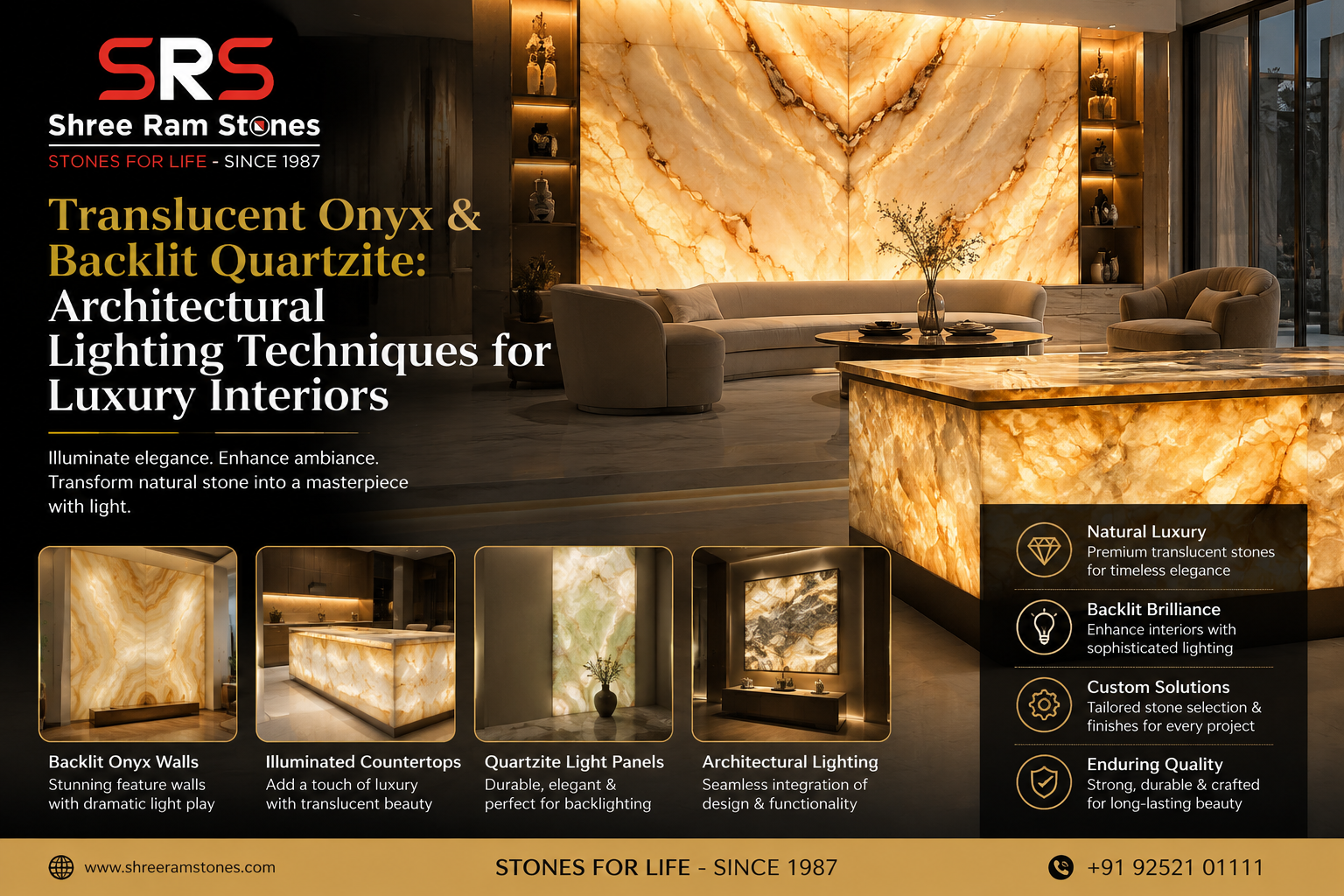
Luxury interiors are increasingly moving beyond conventional lighting and surface finishes. Translucent onyx and backlit quartzite can combine natural stone with architectural lighting to create dramatic walls, counters, reception desks, bars, and statement features.
Unlike ordinary stone surfaces, translucent materials can transmit light through selected areas of the slab. This allows the natural veins, colors, clouds, and mineral patterns to become part of the lighting design. The result is a feature that can look completely different during the day and at night.
A successful installation, however, requires more than placing LEDs behind a stone slab. Stone selection, slab thickness, light distribution, ventilation, electrical access, fabrication, diffusion, and maintenance all need to be considered from the beginning.
This backlit onyx installation guide explains the essential techniques architects, interior designers, homeowners, and hospitality professionals should understand before specifying illuminated natural stone.


8
What Makes Onyx Suitable for Backlighting?
Onyx is particularly valued for its translucent appearance. The Natural Stone Institute explains that the crystalline structure of many onyx varieties contributes to their characteristic translucency.
When light is positioned behind a suitable slab, areas of the stone can glow while veins and natural patterns become visually enhanced. This makes onyx especially attractive for decorative architectural applications.
The effect depends on the individual slab. Two slabs of the same stone variety may transmit light differently because natural stone contains variations in mineral composition, thickness, veining, and density.
Therefore, backlit onyx installation should always begin with a physical sample or the actual slab whenever possible.
For designers sourcing natural stone, Shree Ram Stones – Marble, Granite, Onyx & Quartz Collection offers a range of natural stone materials for residential and commercial applications.
Backlit Onyx Installation Guide: Start With Stone Selection
The most important step is choosing the right stone.
Not every onyx slab is equally translucent, and not every decorative quartzite is suitable for the same lighting effect. Before fabrication, evaluate:
- Overall translucency
- Slab thickness
- Vein density
- Mineral variation
- Surface finish
- Color consistency
- Structural condition
- Intended application
- Desired lighting intensity
Test the Slab Before Fabrication
A simple lighting mock-up can reveal how the stone will perform.
Place a representative sample over the proposed lighting system and evaluate it from the viewing distance. Look for uneven bright areas, dark patches, visible LED points, and unwanted shadows.
This testing stage is particularly important for large luxury feature wall stone installations because replacing fabricated panels later can be expensive.
LED Panel Lighting for Translucent Marble and Onyx
One of the biggest challenges in illuminated stone design is achieving uniform illumination.
A small number of bright LEDs can create visible hotspots behind the slab. Instead, designers generally need a lighting system that distributes illumination evenly across the entire surface.
Why LED Technology Works Well
LED systems offer several advantages for architectural stone applications:
- Low energy consumption
- Long operating life
- Compact installation
- Dimmability
- Multiple color-temperature choices
- Flexible panel and strip configurations
- Reduced heat compared with many traditional light sources
The U.S. Department of Energy notes that LED quality involves factors such as color appearance and color fidelity, while CRI is commonly used to describe color rendering. For interior applications, DOE guidance generally recommends a minimum CRI of 80, with 90+ representing excellent color fidelity.
For premium stone installations, high-quality LEDs with excellent color rendering can help preserve the visual character of the natural material.
Choosing Color Temperature
Color temperature has a major influence on the appearance of illuminated stone.
Warm lighting can emphasize golden, amber, cream, beige, and brown tones. Neutral lighting can provide a cleaner appearance, while cooler lighting can create a contemporary visual effect.
The Department of Energy describes warm light as generally below about 3500K, neutral light around 3500–4500K, and cool light above 4500K.
For a luxury interior, the final choice should be based on the stone’s actual colors and the surrounding materials. Always test the lighting before final installation.
How to Build a Translucent Natural Stone Bar Counter
A translucent natural stone bar counter can become the focal point of a restaurant, hotel, lounge, private residence, or entertainment area.
The basic concept involves creating a controlled cavity behind the translucent stone and installing a carefully distributed lighting system within it.
Important Design Considerations
The supporting structure should provide adequate stability while leaving sufficient space for the lighting system.
Consider:
- Stone thickness – Choose a thickness appropriate for the application and fabrication method.
- Support structure – Ensure the stone is properly supported.
- Lighting cavity – Provide enough space for uniform light distribution.
- Electrical access – Plan wiring and drivers before fabrication.
- Ventilation – Prevent excessive heat accumulation around electrical components.
- Access panels – Make future maintenance possible.
- Edge detailing – Consider how the stone edges will appear when illuminated.
- Mock-up testing – Test the complete lighting and stone combination before installation.
For working surfaces, designers should also consider the stone’s specific physical properties and maintenance requirements. Onyx can be vulnerable to chemical and abrasive attack, so application-specific detailing and care are important.
Creating a Luxury Feature Wall With Backlit Stone
A luxury feature wall stone installation can transform an otherwise ordinary interior into an architectural centerpiece.
Backlit stone is especially effective behind:
- Reception desks
- Hotel lobby walls
- Restaurant counters
- Living-room feature walls
- Bedroom headboards
- Staircase walls
- Luxury bathrooms
- Private bars
- Retail displays
- High-end office reception areas


8
Match the Veining With the Architecture
The stone should not simply be treated as a decorative sheet. Its natural movement can become part of the architectural composition.
Bookmatching is particularly effective when two slabs are arranged so that their patterns mirror each other. When illuminated from behind, the resulting composition can create a dramatic symmetrical feature.
For larger installations, slab layout should be finalized before cutting. This helps preserve important veins and avoids unnecessary visual breaks.
Backlighting Techniques for Translucent Natural Stone
There are several approaches to illuminating translucent stone.
1. LED Panels
LED panels can provide broad, consistent illumination behind the stone. They are particularly useful for large feature walls where uniform brightness is important.
2. LED Strips
LED strips can work well in smaller or specially fabricated cavities. However, positioning is critical to avoid visible lines or hotspots.
3. Diffused Lighting
A diffuser between the LEDs and stone can help distribute light more evenly. The exact diffuser and cavity arrangement should be tested with the selected slab.
4. Dimmable Systems
Dimming allows the same installation to create different moods throughout the day.
For hospitality environments, for example, a brighter daytime setting can transition into a softer evening appearance.
Backlit Quartzite vs. Backlit Onyx
Although both materials can create spectacular illuminated interiors, they should not automatically be treated as identical.
Onyx is often selected for its strong translucency, dramatic colors, and flowing natural patterns. The Natural Stone Institute describes decorative onyx as a material whose striking colors, veining, and translucent properties can produce bold architectural statements.
Quartzite, meanwhile, can provide a different visual character and may be selected where designers want a combination of natural pattern and a particular performance profile.
The exact behavior depends on the specific stone. Therefore, designers should request technical information and conduct lighting tests on the actual material rather than relying only on the stone’s commercial name.
Installation Mistakes to Avoid
Even an expensive stone can lose its visual impact when the lighting system is poorly designed.
Avoid Visible Hotspots
Do not position high-intensity LEDs too close to the slab without testing. Uneven spacing can create bright dots and dark areas.
Avoid Designing Lighting After Fabrication
Lighting should be integrated into the architectural design from the beginning. Electrical connections, driver locations, cavity depth, ventilation, and access must be considered before the stone is cut.
Avoid Ignoring Natural Variation
Natural stone is not a manufactured printed panel. Variation in color, veining, mineral density, and translucency is part of its character.
Avoid Choosing Lighting by Color Alone
Two lights may have a similar Kelvin rating but render the stone differently. Review the actual stone under the proposed lighting system before approval.
Avoid Blocking Maintenance Access
LED components, drivers, and electrical connections may eventually require servicing. A well-designed installation should allow maintenance without unnecessarily damaging the stone.
Maintenance of Backlit Onyx Installations
Maintenance requirements depend on the specific stone, finish, location, and fabrication.
Because onyx can be susceptible to chemical and abrasive damage, harsh cleaners should not automatically be assumed to be suitable.
For luxury installations:
- Use cleaning products recommended for the specific stone.
- Avoid abrasive cleaning materials.
- Remove spills promptly.
- Follow the fabricator’s sealing and maintenance recommendations.
- Inspect lighting components periodically.
- Keep electrical components accessible.
- Avoid excessive heat around LED drivers and power supplies.
For technically demanding projects, consult the fabricator and relevant natural-stone professionals before final specification. The Natural Stone Institute maintains technical resources covering marble and onyx standards, fabrication, installation, repairs, and related considerations.
How Architects Can Specify Backlit Stone Successfully
Architects and designers can reduce installation problems by defining the complete system during the specification stage.
A professional specification should consider:
Stone: Variety, slab selection, thickness, finish and approved sample.
Fabrication: Cutting, edge treatment, reinforcement, joints and bookmatching.
Lighting: LED type, CCT, CRI/color fidelity, dimming, controls and distribution.
Structure: Substrate, support, cavity and ventilation.
Electrical: Driver position, wiring, access and service requirements.
Mock-up: Full-scale or representative sample approval before production.
The most important principle is simple: stone and lighting should be designed as one system.
Why Backlit Natural Stone Creates a Premium Interior
Natural stone already contains characteristics that are difficult to reproduce artificially. When light passes through translucent stone, those characteristics become part of the visual experience.
Veins can appear deeper. Colors can become warmer. Mineral structures can seem to move across the surface. A static wall becomes a changing architectural element.
That is why backlit onyx is particularly effective in luxury hospitality, premium residences, entertainment spaces, reception areas, and statement bars.
When properly engineered, the installation is not merely a wall with lights behind it—it becomes an architectural lighting feature built from natural material.
Choosing a Natural Stone Supplier for Backlit Projects
The supplier’s role is important because successful illumination begins with suitable stone selection.
Look for a supplier that can help with:
- Slab selection
- Natural stone identification
- Translucency assessment
- Large slab availability
- Fabrication coordination
- Project-specific sourcing
- Export requirements
- Technical information
Shree Ram Stones is a marble, granite, onyx and quartz supplier based in Kishangarh, Rajasthan, offering natural stone materials for residential, commercial and architectural applications.
Conclusion
A successful backlit onyx installation guide should go beyond simply explaining how to place LEDs behind a stone slab. The best results come from coordinating stone selection, fabrication, structural support, lighting distribution, color quality, electrical planning, and maintenance from the beginning.
For luxury interiors, translucent onyx can create exceptional visual depth, while carefully engineered LED systems can reveal the natural beauty hidden within the stone.
Whether the project involves a translucent natural stone bar counter, illuminated reception desk, staircase, or luxury feature wall stone, testing the actual slab with the proposed lighting system is one of the most valuable steps in the design process.
Contact Information
Shree Ram Stones
Marble, Granite, Onyx & Quartz Manufacturer, Supplier & Exporter
📍 Address: Makrana Road, RIICO Industrial Area, Kishangarh, Khatoli, Rajasthan – 305801, India
📞 Phone: +91 92521 01111
📧 Email: ceo@shreeramexpo.in | shreeramexpo@gmail.com
🌐 Website: www.shreeramstones.com
Architectural Natural Stone → https://www.stoneexpert.in/